Initial Resistance to AI at Workplace is Waning
Employees are coming to the slow realization that AI, for now, is not a threat to jobs, but rather a tool.


Initial resistance to artificial intelligence (AI) seems to be slowly melting. Concern around job displacement and the fear of being replaced by machines is very much palpable in global offices, but as AI has become more sophisticated and demonstrated its ability to augment human capabilities, these fears are gradually easing. AI is already being used in a wide range of industries, from healthcare to manufacturing to finance. Employees are coming to the slow realization that AI, for now, is not a threat to jobs but rather a tool that can be used to enhance productivity, improve efficiency, and drive innovation.
We also know this: as AI technology develops, its impact on the workplace will only grow. So, keeping a close watch on the employment situation even now is a must. That’s why this newsletter exists.
Before going ahead, let’s look at the weekly AI Job Indicator.
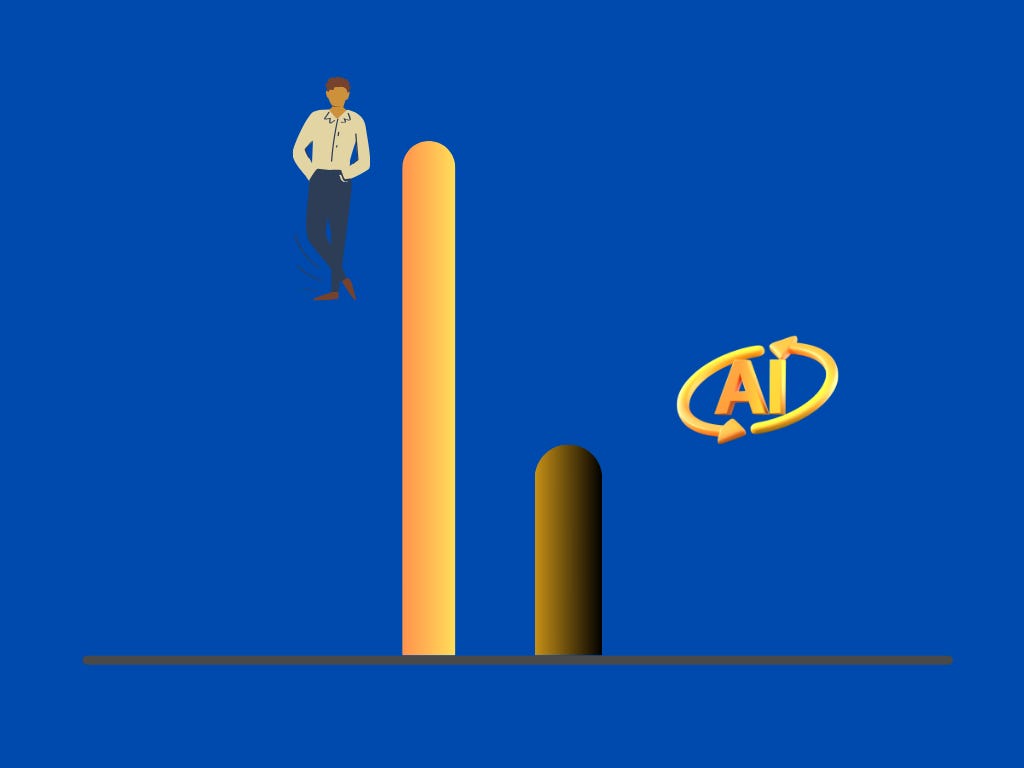
Man crawled back last week after losing consistently to AI, where employment was concerned, over the previous fortnight.
In Today Newsletter:
Study Shows AI Boosts Job Performance for Everyone
Hottest Job These Days: CAIO
Gen-AI Affects Four Sectors The Most: McKinsey
You Can Now Send Your AI Avatar to Zoom Meeting
Here Comes Your Office as Envisaged by Microsoft Mesh
New Report Reveals Global Surge in AI Adoption for Quality Engineering
OpenAI vs Google in Recruiting Talent
Artificial Intelligence Reshaping Indian Workplace Dynamics: Study
Harvard Study Reveals Positive Impact of GPT-4 AI on Employee Productivity
Emotional Intelligence Differentiates Man From Machine in Workplace
Chinese Company’s Open Source AI Models
YouTube’s New Policy for AI-Generated Content
Google's Cybersecurity Forecast 2024 Warns of Rising Threats from AI in Cyber Attacks
Hackers Targeting ChatGPT: OpenAI
Interview with AI Entrepreneur Isabel Costa Pinto
AGI May Surpass Humans Some Day
What Will AGI Come? Three Experts Discuss
Plus, “Top Picks”, “Events” and much more.


The Looming Threat of AI-Powered Privacy Invasion
Most of us are awestruck by the rapid strides being made by generative artificial intelligence (gen-AI). It’s already started to affect our professional and personal lives.
There’s talk of AI co-pilots, virtual assistants and AI agents coming. But this rapid advancement of AI and its integration into our daily lives raises a critical concern: the potential invasion of our privacy and access to our personal data.
As AI agents and co-pilots become increasingly sophisticated, they will have to have access to sensitive information about our habits, preferences, and even our most intimate thoughts and feelings. Without that, they will not be successful in their tasks.
The repercussions of this unchecked access could be profound. AI systems could be used by some, including governments, to manipulate our behavior, target us with intrusive advertising, or even discriminate against us based on our personal data. In the wrong hands, this information could be weaponized to harm individuals and erode the very foundations of our society.
To prevent these potential threats, we must quickly implement robust safeguards and regulations around the development and deployment of AI systems. We need to ensure that AI agents and co-pilots are designed with transparency and accountability in mind, and that their use is subject to strict ethical guidelines.
Moreover, we need to empower individuals with greater control over their personal data. We should have the right to know how our data is being collected, used, and shared, and we should be able to opt out of data collection practices that we find unacceptable.
The integration of AI into our lives is inevitable, but it does not have to come at the expense of our privacy. By taking proactive measures to address the potential risks, we can ensure that AI is used for the benefit of all, not for the intrusion and manipulation of our personal lives.

New Study Shows AI Boosts Job Performance for Everyone
People worry that smart computers might take away office jobs, but a recent Harvard study on the latest AI tech, GPT-4, gives us some good news. The study looked at Boston Consulting Group (BCG) workers using GPT-4 and found they were way more productive. Those who used the AI finished tasks 25% faster, did 12% more work, and their work quality was 40% better.
The surprising part? The most significant improvements were seen in less skilled workers. This goes against what many thought – that only super-skilled people benefit from AI. So, it seems like AI can actually help all kinds of workers do better.
In short, while some worry about losing jobs to AI, this study suggests that AI can actually make work better for everyone, no matter their skill level. Understanding how this plays out in different jobs and industries is key to seeing how AI might affect our work in the future.
Three key insights: Firstly, effective regulation is crucial, especially in the largely unregulated online freelancing market. Without proper safeguards, even knowledge workers face risks.
Secondly, roles that involve diverse tasks are less prone to complete automation. The gig-worker model, where individuals perform single tasks for multiple clients, such as copywriting or logo design, is particularly vulnerable.
Lastly, maximizing the benefits of these tools and avoiding pitfalls requires treating them as extensions of ourselves. It's essential to check their outputs just as we would review our own work. These tools are not separate, infallible assistants to whom we can blindly delegate or surrender responsibility.
In simpler terms, generative AI is like a frenemy for white-collar workers, especially millennials. It's smart to be cautious, but this relationship could turn out to be beneficial with careful handling.
What It Means For Us?
The impact of generative AI on white-collar work is nuanced. While concerns about job loss and work devaluation persist, some research indicates that AI assistance can markedly improve productivity and quality, benefiting employees at all skill levels. A comprehensive understanding of diverse labor markets and industries is essential to fully comprehend the potential implications of generative AI on white-collar jobs.
Source: ft.com
Ladies and Gentlemen, Welcome Your New CAIO
The Chief Artificial Intelligence Officer (CAIO) role is gaining prominence in the C-suite, with 11% of midsize to large organizations already having designated individuals in this position and 21% actively seeking one.
CAIOs are responsible for shaping the overall AI strategy, ensuring ethical AI use, and fostering an AI-first culture, with expectations including leadership in successful AI programs and a vision for organizational transformation.
The article discusses the role of CAIOs in organizations, emphasizing their importance in making strategic decisions and allocating resources for AI investments.
It highlights the responsibilities of CAIOs, such as overseeing AI initiatives, managing budgets, and collaborating with various business units.
Source: cia.com
Gen-AI Affects Four Sectors The Most: McKinsey
Generative AI, powered by deep learning, is a significant advancement within the field of artificial intelligence. It can potentially deliver substantial value across various areas such as customer operations, marketing and sales, software engineering, and R&D. Approximately 75% of the value that generative AI use cases could provide falls within these four sectors.
According to projections, generative AI could contribute to annual labor productivity growth of 0.1 to 0.6% until 2040. The actual impact will depend on the rate of technology adoption and the reallocation of worker time to other activities.
Two different perspectives were used to determine the potential value and scale of generative AI. The analysis identified 63 use cases across 16 business functions, which could generate economic benefits of $2.6 trillion to $4.4 trillion annually across industries.
In order to estimate the impact of generative AI on labor productivity, scenarios were modeled for more than 2,100 detailed work activities performed by the global workforce. By understanding how generative AI could affect these activities, a comprehensive assessment of its capabilities and potential value was achieved. However, it is important to note that while generative AI is an exciting technology, other applications of AI still account for the majority of the overall value potential.
Overall, generative AI has the potential to revolutionize various industries and significantly enhance labor productivity. By leveraging deep learning models, it can deliver substantial economic benefits across customer operations, marketing and sales, software engineering, and R&D. However, it is just one aspect of the broader field of AI, and other applications continue to dominate the overall value potential.
Source: mckinsey.com
It’s Now Possible to Send AI Bots to Zoom Meetings: Bad Form or Convenience?
The latest trend in office culture involves deploying AI bots to represent employees in Zoom meetings. While this may appear as a productivity hack, experts caution that it could harm work relationships and office dynamics.
The use of bots as meeting avatars may inadvertently convey that the meeting lacks importance, potentially undermining the authority of managers and affecting team relationships. Vulnerable groups, such as women with caregiving responsibilities or underrepresented workers, may bear a disproportionate impact, missing out on crucial discussions and opportunities to connect with colleagues.
Additionally, there's concern that the prevalence of bots in meetings might discourage younger employees, especially Gen Z, from engaging in challenging workplace conversations, viewing bots as an easy way to avoid difficult situations. In essence, while relying on AI bots for meetings might offer immediate relief from work pressures, it could pose lasting threats to employee empowerment and agency.
Source: archive.ph
Microsoft Mesh is New Way of Going to Office
Starting in January 2024, “Microsoft Mesh”, which is part of the Microsoft 365 experience, will be generally available. This was announced at Microsoft Ignite event. Mesh offers immersive experiences featuring personalized avatars and interactive activities between colleagues.
From Jan next year, it will offer 3D virtual office atmosphere instead of the present 2D, AI-driven voice isolation, generative backgrounds, customizable reactions, and improved support for code blocks and team management. IT administrators will also gain access to new deployment and collaboration tools.
Microsoft Mesh is a cloud-based platform for collaboration in mixed reality, offering it both as an app and as a service. It allows workers in different physical locations, using different types of devices, to participate and collaborate in a shared immersive space.
Source: Microsoft

New Report Reveals Global Surge in AI Adoption
Approximately 67% of organizations worldwide have integrated quality engineering (QE) into their core business operations, with 77% actively investing in artificial intelligence (AI) solutions to enhance QE, according to a recent report by Capgemini, Sogeti, and OpenText.
The report highlights a notable shift, with 65% of respondents identifying higher productivity as the primary outcome driven by AI, marking a significant change in priorities.
The findings indicate that organizations are moving away from the traditional focus on using AI to increase test reliability (33%) and reduce the number of faults (29%). Instead, there is an emerging emphasis on a testing philosophy that demonstrates an increased tolerance for defects, provided they can be promptly and efficiently addressed.
Source: sentinelassam.com
Intensifying Battle: OpenAI vs Google in Recruiting Talent
The competition for talent between OpenAI and Google is escalating. In an effort to attract top AI professionals from Google, OpenAI recruiters are offering lucrative incentives, including multimillion-dollar packages. The enticing message: Join now to secure a stock package at the current $27 billion valuation and reap the benefits of the upcoming valuation surge.
As part of their recruitment strategy, OpenAI recruiters emphasize enhanced access to computing resources, including specialized chips crucial for running experiments.
Source: information.com
UKG Study: Artificial Intelligence Reshaping Indian Workplace Dynamics
A recent study by UKG, a provider of HR, payroll, and workforce management solutions, highlights the profound impact of Artificial Intelligence (AI) on the future of work. The study delves into the pervasive integration of AI in both the professional and personal lives of employees and employers.
In India, the findings indicate that 72% of employees regularly encounter AI-powered tools, systems, and processes within their organizations. The use of generative AI tools such as Chat GPT (75%), Open AI (47%), and Google Bard (22%) is prevalent in both job-related tasks and personal activities, showcasing the widespread adoption of AI technologies.
With 62% of Indian employees believing that AI skills will surpass work experience in importance within the next two years for job seeking or job retention, there is a growing recognition of the need to acquaint oneself with the intricacies of AI. The study underscores the significance of AI as a key factor in unlocking the potential of the future workplace.
Source: news18.com

Exciting Opportunities for Newsletter Sponsorship!
Discover available ad and sponsorship slots for this newsletter by clicking on this link. Explore the various packages to find the perfect fit for your brand.
If you would like further information, please don't hesitate to contact me. Let's collaborate and customize the best deal tailored to your specific needs. Click on the tab above. Or, for individual requirements, write to marketing (at) newagecontentservices.com
Harvard Study Reveals Positive Impact of GPT-4 AI on Employee Productivity, Warns Against Over-Reliance
A recent Harvard Business School study delved into the influence of AI tools on workplace productivity, specifically focusing on Boston Consulting Group (BCG) employees and their utilization of the GPT-4 AI tool.
The study involved 758 BCG consultants assigned to three conditions: no AI access, GPT-4 AI access, or GPT-4 AI access with a prompt engineering overview. The results showed a significant boost in productivity for the AI group, completing tasks 12.2% more efficiently and 25.1% faster than the control group. Moreover, the AI group exhibited a remarkable 40% increase in task quality compared to their non-AI counterparts.
Notably, consultants across various skill levels benefited from AI augmentation, with a 43% performance increase for those below average and a 17% increase for those above. However, the study identified a drawback, noting that consultants relying on AI were 19% less likely to provide accurate solutions for tasks beyond the capabilities of the AI.
The study outlined two distinct patterns of behavior among consultants using AI: "Centaurs," who divided solution-creation activities between themselves and the AI, and "Cyborgs," who fully integrated their task flow with continuous interaction with the AI.
In summary, the research underscores the positive impact of AI tools on employee productivity but issues a cautionary note against excessive reliance, emphasizing the importance of preserving human judgment and problem-solving skills in tasks beyond the AI's capabilities.
Source: tech.hindustantimes.com
The Human Edge: Emotional Intelligence Differentiates Man From Machine in Workplace
What distinguishes humans from AI in the workplace is emotional intelligence. The ability to form meaningful connections and empathize with others is a crucial factor for business growth, setting humans apart.
AI, constrained by the data it receives, encounters challenges in adapting to new situations. Machines find it difficult to replicate human reasoning and creativity, establishing the unique strength of human thought processes.
In the realm of soft skills, including teamwork and effective communication, humans hold a distinct advantage over AI. The development of these skills is not only beneficial but essential for achieving professional success in a world increasingly influenced by technology.
Source: makeuseof

Chinese Company’s Open Source AI Models
In a groundbreaking move, Chinese startup 01.ai has unveiled the Yi series, boasting models that currently stand out as the most robust openly accessible ones globally. The release includes two models, Yi-6B and Yi-34B, along with extended context variants, Yi-6B-200K and Yi-34B-200K.
Putting these models to the test, Yi-34B achieves an impressive 76.3 score on the MMLU reasoning benchmark, surpassing competitors such as Falcon-180B (70.4) and LLaMA2 (68.9).
Accessing these models is free for academic research. Users must adhere to the company's Models License Agreement, ensuring compliance with local laws and regulations, and refraining from military applications, among other restrictions.
What It Means For Us?
01.ai's model release establishes the company as a credible force capable of developing impactful and robust AI models. While this achievement would be noteworthy in a Western context, it holds even greater significance in China, where large-scale generative models have typically been dominated by major local tech companies or Tsinghua University-affiliated labs. If 01.ai successfully scales its models despite domestic computing challenges, it could emerge as a key player in advancing frontier AI.
Source: 01.ai
YouTube Introduces Policy Requiring Disclosures for AI-Generated Content
YouTube is implementing a new policy that mandates disclosures on videos featuring content generated by artificial intelligence to prevent potential viewer confusion. The Google-owned platform, which already prohibits misleading content, will now require creators to include labels when uploading content that incorporates "manipulated or synthetic content that is realistic, including using AI tools."
This policy update aims to address the rising prevalence of consumer-facing generative AI tools, making it easy to produce text, images, video, and audio that closely resemble real content. The required labels will specifically apply to AI-generated or synthetic content that appears "realistic," covering scenarios such as videos depicting events that never occurred or content portraying individuals saying or doing things they did not actually do. The move is intended to enhance transparency and help viewers distinguish between genuine and AI-generated content.
Source: cbsnews.com
Google's Cybersecurity Forecast 2024 Warns of Rising Threats from AI in Cyber Attacks
As technology advances, especially with developments like generative AI, the landscape of cybersecurity attacks is becoming more sophisticated. Google's newly released cybersecurity forecast sheds light on the emerging threats associated with the increasing use of AI.
On Wednesday, Google unveiled its Google Cloud Cybersecurity Forecast 2024, a comprehensive report collaboratively compiled by various Google Cloud security teams, providing an in-depth analysis of the cyber landscape for the upcoming year.
The report highlights that generative AI and large language models (LLMs) are anticipated to play a significant role in diverse cyber attacks, including phishing, SMS scams, and other social engineering operations. The objective is to create content, such as voice and video, that appears more authentic and legitimate.
For instance, traditional indicators of phishing attacks, like misspellings, grammar errors, and the absence of cultural context, will become more challenging to identify when generative AI is employed. This is because AI excels at mimicking natural language, making it crucial for users to be vigilant in recognizing these evolving cyber threats.
Source: zdnet.com

“AI For Real” Is On LinkedIn. Join, Now.
“AI For Real” Is Also On Facebook Now. Join here.
Here’s Our Twitter Account.
Subscribe to Our YouTube Channel: youtube.com/@aiforreal
Hackers Targeting ChatGPT: OpenAI
OpenAI is currently contending with disruptions caused by "abnormal traffic," indicating that hackers are attempting to overwhelm its services. This marks the first acknowledgment of the potential cause behind the recent outages affecting ChatGPT.
The startup, backed by Microsoft Corp. and renowned for its contributions to global generative AI development, revealed evidence of a Distributed Denial of Service (DDoS) attack. In this type of attack, external actors aim to overload a platform by consistently bombarding it with requests.
In its most recent system update, OpenAI stated it was dealing with periodic outages due to an abnormal traffic pattern reflective of a DDoS attack.
Source: bloomberg.com


In the 8th episode of “60 Secs With AI Founders”, I spoke* with Isabel Costa Pinto, an entrepreneur from Portugal, a marketer and Co-Founder of startup “Dailycrowds”. By her own admittance, she is currently devoted to the mission of making everyone in the world a little happier, with the help of this new networking startup.
Dailycrowds is a search & discovery community for daily inspiration and happiness powered by the crowds.
Q&A
Q1) The challenges of being an AI entrepreneur: Name 2 big challenges you've faced as an AI entrepreneur.
Isabel: Due to the high level of innovation of the technology we are now presenting, the main challenge was the development process of the AI itself. In our case, it not only took years of complete, deep focus on conceiving and building this system but also required absolute precision in algorithm performance and in the way everything was being created due to resource constraints we faced at all levels. This tight management in building an initial infrastructure with the awareness that it would be applied to a concept with the potential to create a new chapter on the Internet was the greatest challenge as entrepreneurs up to this point.
In addition to this development phase, we can also mention that operating in a "futuristic" field, where not everyone believes our work yet, is always more challenging in terms of gaining understanding from not only the business world but it’s always a challenge to start to get to our audience. The market is now much more receptive to the AI topic, but when we started developing our technology many years ago, it didn't have the recognition and applause it does now.
Q2. Name 2 of the biggest opportunities you see in the AI industry.
Isabel: The biggest opportunity, for me, is exactly this one related to what Dailycrowds is bringing to the world: the chance to save so much time and daily efforts, the magic of finding what we need and even what we didn’t even know we needed, while also organizing our lives, having more time, saving money, and maybe even making more money, because we also have new means to go after our dreams. AI gives us tools that weren’t available until this point – and in our case we do it with specific tech features that are very innovative and useful, life changing for our everyday lives – and it consequently transforms the course of our reality.
From a broader perspective, I believe that AI brings us greater flexibility through a wider range of solutions and assistance for what we needed more routinely. What we gain in terms of independence and practicality is something that is becoming increasingly evident every day, right in front of us, but we must keep in mind that only in articulation with a very human-centered management can good results be possible. There are significant growth opportunities with the level of innovation we have reached, but AI has to remain a tool and a support, never the heart of a project.
Q3) Do you think AI is a job gobbler or just a smart assistant, as of now?
Isabel: AI has come to empower people, not to replace them. Humans may gain more freedom concerning tasks that gradually become replaceable, and that must be a good thing. Throughout history, there have always been technological advancements that marked the end of certain "eras" in terms of work methods, and several job categories were lost in that process, which is concerning at first but will always be part of evolution. However, these transformations typically apply to what is considered "mass work," which, on the other hand, makes what we feel craftsmanship even more valuable and treasurable.
As science seeks to gain ground or becomes more prominent, the art of "going back to the roots", its opposite, also gains even more strength. The world has always been about naturally seeking balance, and right now, we are all a bit lost and a bit scared as we search for a new point of well-being that benefits everyone.
(*Interviews in this segment are edited for clarity and brevity.)
- Your story matters. Your innovation matters -
Do you want to be featured in “60 Seconds With AI Founders”? Are you an AI entrepreneur, startup founder, AI product builder, or the head of an AI non-profit? You can get your point of view across to the rest of the world.
Reply in the Comments section here or email marketing (at) newagecontentservices.com with the subject line: Yes to 60 seconds. I shall revert.

..where every week, I shortlist interesting articles, posts, podcasts, and videos on AI
AGI May Surpass Humans Some Day
This is a very interesting article by Dr. Tehseen Zia that explores the limitations of current narrow AI, emphasizing the need for Artificial General Intelligence (AGI) that mirrors human cognition.
It introduces the concept of recursive self-improvement in AI, drawing parallels to the evolutionary process of human general intelligence.
The article suggests that autonomous learning and modification of AI's foundational code could lead to a transformative shift, potentially resulting in a technological singularity where AI surpasses human intelligence exponentially.
AI's self-replicating and self-improving abilities could lead to rapid progress, but pose significant risks.
While promising, implementing recursive self-improvement requires cautious management due to potential challenges and uncertainties in current technology.
Source: techopedia.com
What Will AGI Come? Three Experts Discuss
This rather unusual article focuses on an interview-style discussion between three experts regarding AI forecasting models, particularly in terms of training compute requirements for achieving Artificial General Intelligence (AGI).
The three are Ajeya Cotra from Open Philanthropy, Daniel Kokotajlo from OpenAI and Ege Erdil from Epoch. Despite each spending at least hundreds of hours investigating this question, they still disagree substantially about the relevant timescales.
Source: lesswrong.com